Skip to content
Amara.org

Amara.org

Advancing Media Accessibility and Audiovisual Translation

  • Services
    • Audio & Video Transcription
    • Captioning
    • Subtitle Translation & Localization
    • Text Translation & Localization
  • Subtitle Editor Solutions
    • Amara Personal Orders Workspace
    • Amara Plus
    • Amara Enterprise
      • Pay-Per-Use
      • Pay-Per-Seat
    • Amara Editor Integration
  • Industries
    • Education and eLearning
    • Film, Television, and Entertainment
    • Government and Public Services
    • Museums and Cultural Institutions
    • News and Journalism
    • Nonprofits
    • Religious and Faith-Based
    • Corporate
  • Resources
    • Accessibility Statement
    • Languages Supported
    • Announcements
    • Features and Developments
    • Start Volunteering
  • Amplifying Voices
    • Become a Volunteer
    • Content Partners
      • Association of African Universities (AAU)
      • All Out
      • CIVIX
    • Projects
      • Accessibility and Inclusion
      • Black History
      • Civic Participation and Democracy
      • COVID-19 Pandemic
      • Diversity and Equality
      • Endangered Languages
      • Environment and Climate Change
      • Gender Diversity
      • Greenwashing
      • Human Trafficking
      • Hunger
      • Indigenous Peoples’ Rights
      • Mental Health
      • Misinformation and Disinformation
      • Musical Education
      • Neurodiversity
      • Ocean Protection
      • Promoting Girls Education
      • Promotion of Literacy Worldwide
      • Recycling and Upcycling
      • Refugee Crisis and Solutions
      • Rewilding
      • Sexual Diversity
      • Sustainable Societies
      • Wildfires
      • Wildlife Protection
  • Categories
    • Artículos en español
    • Artigos em português
    • Articles en français
    • Guest Posts
    • Partners
    • Team Member Spotlight
    • Amara On Demand
    • Amara Enterprise Platform
    • Volunteering
    • Accessibility and Captioning
    • Audio and Video Transcription
    • Captions and Subtitles
    • Culture and Appreciation
    • Language Diversity Preservation
    • Solutions and Tools
    • Subtitling and Global Reach
    • Technology and Work
    • Transcreation and Cultural Adaptation
    • Translation and Localization
    • Corporate
    • Digital Video Creators
    • Film and Television
    • Nonprofits
    • Podcast
  • Toggle search form
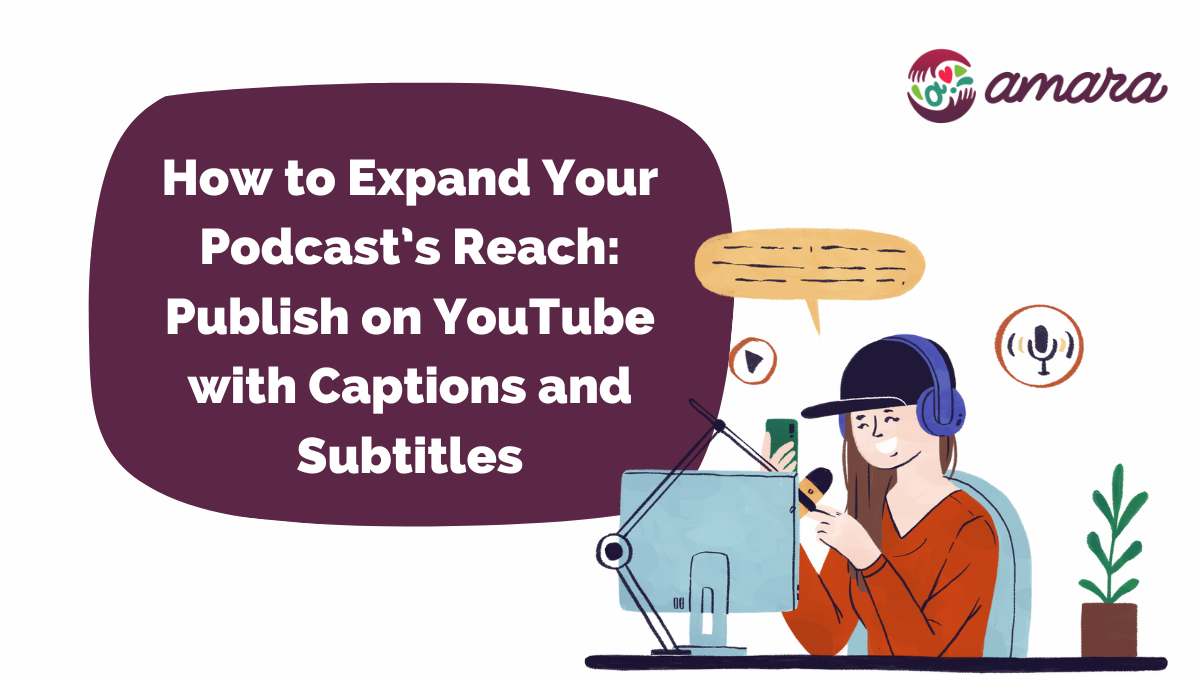
A rectangular image with the title of the article at the top-left side. There's also an illustration of a podcaster on the down-right side, the podcaster is sitting in front of a computer, is holding a phone and is speaking into a microphone.

How to Expand Your Podcast’s Reach: Publish on YouTube with Captions and Subtitles

Posted on May 27, 2025May 27, 2025 By amarasubs No Comments on How to Expand Your Podcast’s Reach: Publish on YouTube with Captions and Subtitles

Podcasting has become a powerful medium for sharing stories, insights, and discussions. However, if you’re only publishing on traditional podcast platforms, you might be missing a significant opportunity to reach a wider audience. YouTube, the second-largest search engine in the world, offers podcasters a chance to expand their listener base, increase discoverability, and engage audiences in new ways. But to truly maximize your reach, adding captions and subtitles is essential. Here’s why.

1. YouTube: A Game Changer for Podcasters

YouTube isn’t just for video—it’s a thriving space for spoken content. With its vast user base, YouTube offers podcasters an additional avenue to attract new listeners. Many users already turn to YouTube for audio-based content, making it a natural extension of your podcast distribution strategy.

By uploading your episodes as video (even with a static image or simple visual elements), you tap into YouTube’s powerful recommendation algorithm, increasing your chances of organic discovery. Plus, YouTube allows monetization options, giving you potential revenue streams beyond sponsorships and donations.

2. Captions Improve Accessibility and Engagement

Not all potential listeners can consume audio content the same way. Some may be hard of hearing, while others might prefer reading along with the dialogue. Adding captions to your YouTube videos ensures that your content is accessible to everyone, making your podcast more inclusive.

Moreover, captions keep viewers engaged. Studies show that people are more likely to watch a video to completion when captions are available. Whether someone is in a noisy environment or prefers to consume content without sound, captions ensure your message is still received.

3. Subtitles Unlock Global Audiences

Why limit your audience to just one language? Adding subtitles in multiple languages allows you to reach international listeners who may not be fluent in your podcast’s primary language. This is especially important for niche content with global appeal.

Human-translated subtitles are the gold standard for accuracy and nuance, but AI-powered solutions can also help bridge language gaps efficiently. The key is ensuring that your translated subtitles maintain the tone and clarity of your original content.

4. SEO Benefits: Captions and Subtitles Improve Discoverability

YouTube relies on text-based data to understand video content. While its automatic captions help with indexing, manually uploaded captions and translated subtitles give you greater control over how your content is interpreted by YouTube’s algorithm.

Including searchable keywords in your captions can improve your ranking in both YouTube and Google search results. Additionally, multilingual subtitles allow your podcast to appear in search results for different language speakers, driving more organic traffic to your channel.

5. How to Get Started with Captions and Subtitles

Adding captions and subtitles to your YouTube podcast doesn’t have to be complicated. Here’s[ how to get started:

  • Use a transcription tool or service to generate AI-based or professional captions for your podcast.
  • Edit captions for accuracy, ensuring they reflect the actual dialogue. If you don’t want to do it yourself, hire the service of a professional editor.
  • Upload subtitles in different languages to expand your global reach.
  • Consider paid services to streamline the process with professional-quality subtitling solutions.
  • If you need help, check out Amara.org to learn more about our professional services that can assist you through any of these steps.

Final Thoughts

Publishing your podcast on YouTube and incorporating captions and subtitles is a smart strategy for expanding your reach, improving accessibility, and boosting discoverability. With a global audience just a few clicks away, why not make your podcast available to as many people as possible?

Contact us today at client-services@amara.org to tell us more about your podcast and our dedicated Project Managers will assist you in finding the best transcribing solutions to make your content discoverable, engaging, and truly accessible to audiences across the globe.

Take the next step today—start uploading, transcribing, translating, and reaching new listeners worldwide!
Read these articles next

Accessibility and Captioning, Captions and Subtitles, Digital Video Creators, Podcast Tags:captions and subtitles, media accessibility, podcast, video podcast, YouTube

Post navigation

Previous Post: The Art of Dialogue:  Why Human Translators Capture Emotion and Subtext Better
Next Post: Boost Retention, Inclusion, and Engagement: Why Captions and Transcripts Are Essential for Corporate Teams

More articles to learn from

Square rectangular image featuring the text “International Day of Sign Languages. Why Accessible Captions Matter.” The design includes illustrations of two signing hands, a speech bubble with caption lines, and the Amara logo. International Day of Sign Languages: Why Accessible Captions Matter Accessibility and Captioning
Rectangular image, with the title of the article highlighted at the top, "Celebrating Spanish in the United States. Why Subtitling Matters During Hispanic Heritage Month." Below is a heart-shaped illustration of diverse hands in different colors coming together, with the Amara logo in the lower-right corner. Celebrating Spanish in the United States: Why Subtitling Matters During Hispanic Heritage Month Accessibility and Captioning
Rectangular image with the title of the article at the top, “How Captions Can Support Literacy and Language Learning,” featuring an illustration of a women reading a book at a computer. The Amara logo is on the bottom-right corner. How Captions Can Support Literacy and Language Learning Accessibility and Captioning
Rectangular image with the title of the article highlighted a the top, "Broadcast Captions vs. Web Captions vs. OTT Subtitles: Choosing the Right Solution for Your Video Content". At the center, we have an illustration of a person working on a computer, with video content. The Amara logo is at the bottom-right corner. Broadcast Captions vs. Web Captions vs. OTT Subtitles: Choosing the Right Solution for Your Video Content Captions and Subtitles
Rectangular image. To the left, the title of the article, “What Are Language Codes? Why They Matter for Professional Subtitle Translation and Localization.” On the right are three overlapping speech bubbles in green, blue, and cream, featuring language-related symbols. The Amara logo appears at the bottom center. What Are Language Codes? Why They Matter for Professional Subtitle Translation and Localization Amara On Demand
Rectangular image highlighting the article title, "International Day of the World’s Indigenous Peoples: How Captions and Subtitles Help Preserve Indigenous Languages”. At the center, an illustration of two happy people communicating through speech bubbles containing a globe. Amara logo at the bottom. International Day of the World’s Indigenous Peoples: How Captions and Subtitles Help Preserve Indigenous Languages Audio and Video Transcription

Leave a Reply Cancel reply

Your email address will not be published. Required fields are marked *

Give us a follow:

  • Bluesky
  • Facebook
  • Instagram
  • LinkedIn
  • YouTube

Contact us at enterprise@amara.org

Powered by PressBook Grid Blogs theme