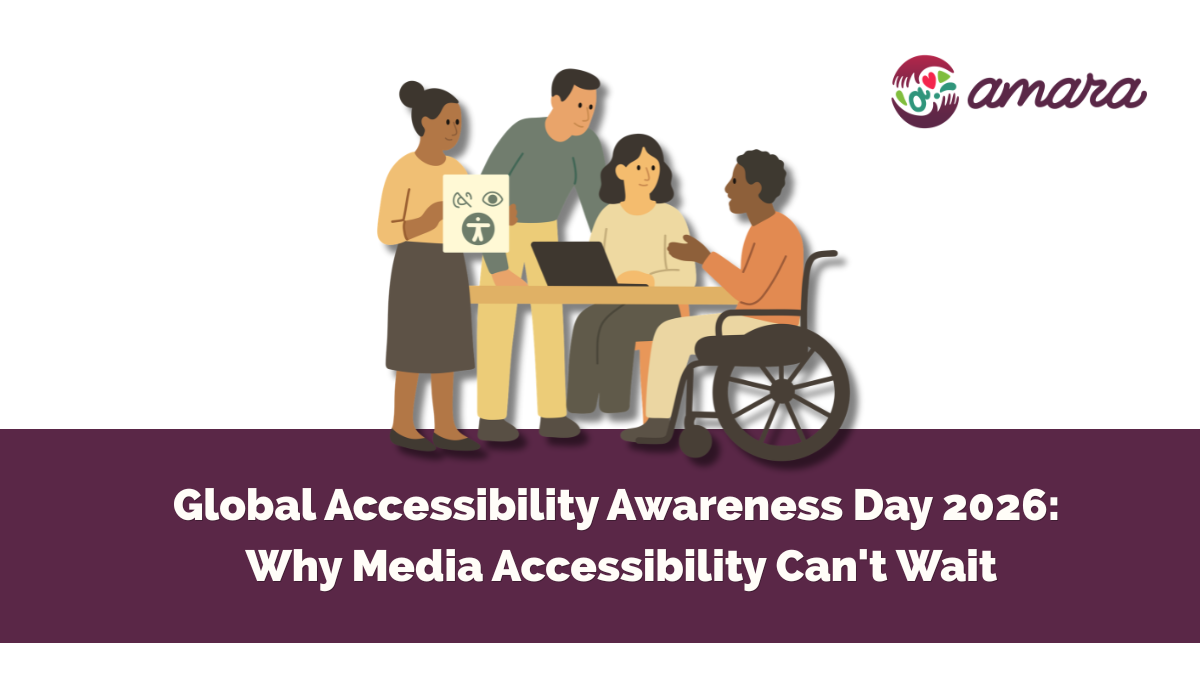
Every year on the third Thursday of May, the world pauses to observe Global Accessibility Awareness Day (GAAD) — a moment to get people talking, thinking, and learning about digital access and inclusion for the more than one billion people worldwide living with disabilities. This year marks the 15th anniversary of GAAD, and the call to action has never been more urgent.
At Amara, we believe accessibility isn’t a feature — it’s a fundamental right. And nowhere is that right more neglected than in the world of digital media.
What Is Global Accessibility Awareness Day?
Global Accessibility Awareness Day was created to shine a light on digital access and inclusion. It’s a day for developers, designers, content creators, organizations, and everyday users to reflect on how digital products and services either welcome or exclude people with disabilities.
The GAAD Foundation — launched in 2021 to mark GAAD’s 10th anniversary — exists to disrupt the culture of technology and digital product development to make accessibility a core requirement, not an afterthought.
The numbers tell a sobering story. According to the WebAIM Million Report, 98.1% of the top one million home pages have at least one WCAG 2.0 failure, with an average of nearly 61 errors per page. Across the digital ecosystem, people with disabilities routinely encounter barriers that sighted, hearing, or neurotypical users never notice.
The Disabilities That Digital Barriers Affect
GAAD recognizes four broad categories of disability that digital inaccessibility impacts every day:
Visual — People who are blind or have low vision rely on alternative text, keyboard navigation, and screen readers to engage with digital content. Images, infographics, and videos that lack descriptions effectively shut them out.
Hearing — People who are deaf or hard of hearing need captions and subtitles for video content, as well as visual cues in place of audio signals. Without them, video — the dominant content format of our time — is largely inaccessible.
Motor — People with motor impairments depend on adaptive hardware, eye-tracking technology, or alternative keyboards to navigate devices. Interfaces that require precise clicking or rapid interaction can become impassable.
Cognitive — People with learning disabilities or cognitive impairments benefit from plain language, consistent navigation, and uncluttered design. Complex or inconsistent interfaces create unnecessary friction.
Why Media Accessibility is one of the defining challenges of our time
Video content has exploded. From streaming platforms and social media to online education, workplace training, and news, video is now the primary way information is communicated online. And yet, for hundreds of millions of people with hearing disabilities alone, the majority of that content remains inaccessible.
Captions and subtitles are not just “nice to have.” They are the difference between being informed and being left out. They are how a deaf student follows a university lecture. They are how a hard-of-hearing professional participates in a company all-hands. They are how billions of people — including non-native speakers and people watching in noisy environments — engage with content at all.
This is exactly where Amara’s mission becomes essential.
How Amara Advances Media Accessibility
Amara is a leading platform for video captioning, subtitling, and translation, built on the belief that every video deserves to be understood by everyone. We provide tools, workflows, and professional services that make it possible for organizations of all sizes to create accurate, high-quality captions and subtitles at scale.
Amara’s Platform Plans
Amara offers a range of Subtitling Editor and Team plans designed to meet different needs — from community volunteers to large enterprises. Every plan includes access to Amara’s award-winning subtitle editor, which supports over 400 languages and requires no software installation.
Amara’s Professional Subtitling Services
Beyond the platform, Amara offers a full suite of human-powered transcription, captioning, and subtitling services through Amara On Demand.
Volunteer to Caption: The Captions Requested Team
One of the most direct ways to make a difference this GAAD is to volunteer your time as a captioner. Amara’s Captions Requested team is an open community space where Deaf and hard-of-hearing users submit videos they need captioned — and any Amara member can step in to help.
With over 10,000 members and nearly 1,900 videos awaiting captions, Captions Requested is a living, breathing example of what community-powered accessibility looks like. These aren’t abstract statistics — they are real people who have reached out and asked, directly, to be included. Every video in that queue represents someone who wants to watch, learn, or engage with content that is currently out of reach.
You don’t need to be a professional subtitler to contribute, but here are some key Subtitling Guidelines from the Amplifying Voices Team that you can follow to create high-quality SDH captions and subtitles. Amplifying Voices is another sister project of Amara, and you’re also welcome to join its team if you want to volunteer to subtitle their videos!
Any Amara member can join the Captions Requested team and start captioning straight away using Amara’s award-winning subtitle editor. Even captioning one video is a meaningful act of inclusion.
👉 Join the Captions Requested team and start volunteering today
- Click on “Join the team”
- On the “Dashboard”, you’ll see the most recent videos added that need your help or click on “Find more videos that need subtitling.”
- Select the video you want to caption.
- Click on “Add/Edit subtitles” and start captioning!
If you’re d/Deaf or hard of hearing and need a video captioned, you can also submit it directly to the team — putting your request in front of thousands of community volunteers ready to help.
👉Submit a video to the Captions Requested team
- Click on “Join the team”
- Click on the “Video” tab
- Click on “Add videos” and your video is posted for volunteers in the team to start captioning!
Why Human-Quality Captions Matter for SEO — and Inclusion
Accurate captions do more than serve people with disabilities — they improve search engine optimization for video content. Search engines cannot watch a video, but they can index caption files. Properly captioned videos rank higher in search results, appear in more video searches, and are surfaced more often in recommendations. Investing in media accessibility is also an investment in content discoverability.
Amara’s captioning solutions produce SRT, VTT, and SBV caption files fully compatible with YouTube, Vimeo, Kaltura, and major streaming platforms — making it straightforward to publish accessible, SEO-friendly video content at scale.
What You Can Do This GAAD
GAAD is a call to action, not just a moment of awareness. Here are concrete steps organizations and individuals can take today:
- Audit your video library. How many of your videos currently have accurate captions? Platforms like YouTube auto-generate captions, but auto-captions consistently contain too many errors to be reliably accessible. Review and correct them — or use Amara On Demand for professional results.
- Commit to captioning new content. Going forward, treat captioning as a mandatory step in your video publishing workflow, not an optional extra.
- Go multilingual. Accessibility doesn’t stop at English captions. If your audience is global, subtitles in additional languages extend your reach and deepen your inclusion commitment. Amara’s translation services and volunteer community make multilingual subtitling achievable for any budget.
- Volunteer your skills. If you have time and good attention to detail, consider volunteering as a captioner. Amara’s Captions Requested team connects community volunteers with videos that Deaf and hard-of-hearing users have specifically asked to have captioned. Learn more about volunteering with Amara.
- Educate your team. Share GAAD resources with your colleagues. Many accessibility failures persist simply because teams don’t know they exist. Start the conversation.
- Participate in GAAD events. Visit accessibility.day to find events near you or online, and consider hosting your own to build awareness within your organization.
Accessibility Is Not Optional — It’s a Civil Rights Issue
GAAD’s founders have always been clear: digital accessibility is not a technical nicety. It is a civil rights issue. One billion people with disabilities represent an enormous portion of humanity who are systematically underserved by digital products built without them in mind.
For media publishers, educators, nonprofits, and enterprises alike, the question is no longer whether to prioritize accessibility — it’s how quickly you can get there.
Amara.org exists to help you answer that question. Whether you’re a community volunteer captioning videos for the d/Deaf community or an enterprise managing thousands of hours of content annually, our platform plans and professional services are built to meet you where you are — and move you toward a fully accessible media library.
Join the Movement
This Global Accessibility Awareness Day, we invite you to take one step — however small — toward more accessible media. Caption a video. Review your existing subtitles. Share this article with your team. Volunteer with the Captions Requested community. Or explore Amara’s platform plans and find the right solution for your organization.
Because the billion people who depend on accessible media aren’t waiting for the world to be ready. They deserve to be included now.
Amara is a nonprofit-founded platform dedicated to making the world’s video content accessible to everyone. Learn more at amara.org.Explore how Amara’s Enterprise platform and On Demand partnerships can power your subtitling needs. Visit Amara.org or email us at client-services@amara.org