Skip to content
Amara Accessibility Media

Amara Accessibility Media

Building access to global information through transcripts, captions, and subtitles

  • Categories
    • Accessibility and Captioning
    • Audio and Video Transcription
    • Captions and Subtitles
    • Culture and Appreciation
    • Language Diversity Preservation
    • Solutions and Tools
    • Subtitling and Global Reach
    • Technology and Work
    • Transcreation and Cultural Adaptation
    • Translation and Localization
    • Volunteering
    • Amara On Demand
    • Amara Enterprise Platform
    • Artículos en español
    • Artigos em português
    • Articles en français
  • Industries
    • Arts
    • Corporate
    • Digital Video Creators
    • Education
    • Film and Television
    • News
    • Nonprofits
    • Podcast
  • Professional Services
    • Audio and Video Transcription
    • Professional Captions
    • Subtitle Translation
    • AI Captions
    • AI Subtitles
    • Text Translation
  • Platform Solutions
    • Amara Public (Free)
    • Amara Plus
    • Amara Enterprise
    • Amara Editor Integration
  • Amplifying Voices
    • Become a Volunteer
    • Content Partners
      • Association of African Universities (AAU)
      • All Out
      • CIVIX
    • Projects
      • Accessibility and Inclusion
      • Black History
      • Civic Participation and Democracy
      • COVID-19 Pandemic
      • Diversity and Equality
      • Endangered Languages
      • Environment and Climate Change
      • Gender Diversity
      • Greenwashing
      • Human Trafficking
      • Hunger
      • Indigenous Peoples’ Rights
      • Mental Health
      • Misinformation and Disinformation
      • Musical Education
      • Neurodiversity
      • Ocean Protection
      • Promoting Girls Education
      • Promotion of Literacy Worldwide
      • Recycling and Upcycling
      • Refugee Crisis and Solutions
      • Rewilding
      • Sexual Diversity
      • Sustainable Societies
      • Wildfires
      • Wildlife Protection
  • Updates
    • Amara Announcements
    • Features and Developments
    • Amara Partners
    • Amara Team Guest Posts
    • Amara Team Member Spotlight
    • Volunteer
  • Toggle search form
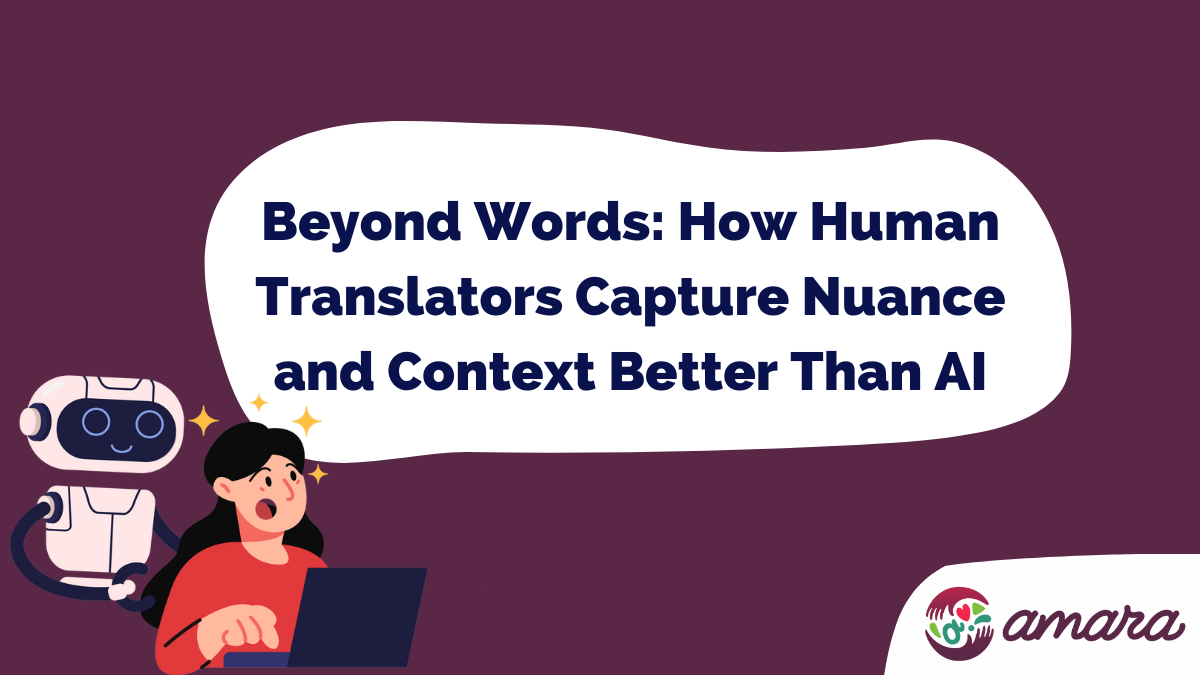
A rectangular image with a plum colored background. The article title is in the center "Beyond Words: How Human Translators Capture Nuance and Context Better Than AI". There's an illustration of a person working on the computer with a robot behind them on the left side.

Beyond Words: How Human Translators Capture Nuance and Context Better Than AI

Posted on January 28, 2025February 25, 2025 By amarasubs No Comments on Beyond Words: How Human Translators Capture Nuance and Context Better Than AI

Language is more than a string of words; it is a vessel of culture, emotion, and nuance. In an era dominated by rapid technological advancement, AI-powered translation tools promise speed and convenience but often fall short in capturing the depth and intricacy of human communication. Let’s show the unique strengths of human translators in preserving nuance, context, and cultural sensitivity, highlighting the essential role they play in bridging linguistic and cultural divides.

The Human Edge: Translating Beyond Words

Nuance in Language: More Than a Dictionary

Language is inherently ambiguous. Words can have multiple meanings depending on context, tone, and cultural nuances. For example, idiomatic expressions like “spill the beans” or “kick the bucket” carry meanings that cannot be deduced by literal translation. Human translators, equipped with an understanding of both linguistic subtleties and cultural underpinnings, excel at conveying the intended meaning rather than a direct word-for-word translation.

AI tools, by contrast, often struggle with idioms, metaphors, and figurative language. While machine translation algorithms can process vast datasets, they cannot yet replicate the depth of comprehension a human translator brings to complex or emotionally charged texts.

Emotional Resonance in Translation

Languages convey emotions in profoundly different ways. A poem, a heartfelt letter, or a story may rely on tone, rhythm, and word choice to elicit specific feelings. Human translators can recognize and replicate emotional resonance in ways that AI cannot.

For instance, translating a eulogy or love letter requires more than linguistic proficiency; it demands empathy and an ability to capture the sentiment behind the words. Machines, lacking emotional intelligence, risk producing flat, tone-deaf renditions of such texts.


Context and Culture: A Translator’s Compass

Understanding Cultural Sensitivity

Cultural knowledge is vital to accurate and meaningful translation. A skilled human translator considers context, audience, and cultural nuances when interpreting text. For example, translating marketing materials for a global audience requires adjusting not only language but also imagery and messaging to suit regional sensitivities.

AI often misses these nuances, leading to awkward or even offensive outcomes. A misstep in cultural translation can damage reputations and alienate audiences, underscoring the need for human oversight in culturally sensitive materials.

Contextual Awareness

Words take on different meanings in different contexts. A single phrase might be formal in one situation and casual in another. Human translators excel at discerning these distinctions, ensuring translations are appropriate for their intended context.

AI, while advancing in context recognition, often lacks the depth to handle complex or ambiguous situations. Misinterpretations are especially common in legal, medical, and literary translations, where a misplaced nuance can have significant consequences.


Why Humans Matter in the Age of AI

Augmenting, Not Replacing, Human Expertise

AI tools have their place in the translation landscape. They are valuable for initial drafts, repetitive tasks, and handling large volumes of text. However, their limitations highlight the necessity of human involvement for quality assurance.

Human translators complement AI by refining machine-generated output, correcting errors, and ensuring cultural and contextual appropriateness. This synergy between humans and technology offers a way to leverage the strengths of both while mitigating their weaknesses.

Preserving Humanity in Communication

At its core, translation is about connecting people. Human translators bring an understanding of culture, emotion, and nuance that fosters authentic communication. In fields such as literature, diplomacy, and social justice, this human touch is indispensable.


Conclusion

While AI continues to revolutionize the translation industry, its limitations in capturing nuance and context underscore the irreplaceable value of human translators. Translators play a vital role in fostering understanding across linguistic divides by preserving the emotional depth, cultural sensitivity, and contextual awareness that define human communication.

To ensure that your content is accurately translated and culturally relevant, consider leveraging the expertise of professional translators. Platforms like Amara.org, run by the Participatory Culture Foundation, offer a collaborative space where creators can engage with professional translators and volunteers alike, bridging the gap between speed and quality. Amara’s tools provide the flexibility of automated translation with the added layer of human oversight, ensuring that translations are not only fast but also culturally and contextually accurate. 

By valuing the contributions of human translators and promoting collaboration between technology and expertise, we can ensure that the art of translation remains true to its purpose: connecting people across cultures with authenticity and precision.
Read these articles next

Amara On Demand, Captions and Subtitles, Technology and Work, Transcreation and Cultural Adaptation, Translation and Localization Tags:ai, cultural adaptation, human translation, translation

Post navigation

Previous Post: New to Amara: Bondo Language!
Next Post: Verbatim vs. Non-Verbatim: Which Podcast Transcription Style Is Right for You?

More articles to learn from

A rectangular image with the title of the article on the top-right corner, the text reads: Cómo los subtítulos pueden impulsar tu contenido audiovisual en español hacia nuevos mercados — y cómo Amara.org puede ayudarte. At the left side of the image there's an illustration of a audiovisual imagery, that's showing the globe. Cómo los subtítulos pueden impulsar tu contenido audiovisual en español hacia nuevos mercados — y cómo Amara.org puede ayudarte Artículos en español
A rectangular image, with an illustration of persons with disabilities on the bottom and the title of the article is at the top. The title reads: Commemorating the International Day of Persons with Disabilities (3 December 2025). Commemorating the International Day of Persons with Disabilities (3 December 2025) Accessibility and Captioning
A rectangular image with the title of the article at the bottom-center, the title reads: Gratitude Around the World: Celebrations Like Thanksgiving and the Power of Accessible Storytelling. At the top, there's an illustration of several hands holding letter cards, the letters form the words "thank you". Gratitude Around the World: Celebrations Like Thanksgiving and the Power of Accessible Storytelling Accessibility and Captioning
A rectangular image with the title of the article on the left-center, the title reads: International Day for Tolerance: How Subtitles and Captions Open Doors to Understanding. On the right-center, we have an illustration of three people with speech symbols on top of their head, the one in the middle contains a checkmark, demonstrating "understanding". International Day for Tolerance: How Subtitles and Captions Open Doors to Understanding Accessibility and Captioning
A rectangular image with the title of the article on the left-center, the title reads: Honoring Native Heritage: The Role of Captions in Preserving Indigenous Languages and Stories. And on the right-center, we have an illustration of a screen with the play button and subtitles. Honoring Native Heritage: The Role of Captions in Preserving Indigenous Languages and Stories Accessibility and Captioning
A rectangular image with the title of the article at the top-left corner, the title is in Brazilian-Portuguese and it reads: Legendagem como Ferramenta para Alcançar o Mercado Global Legendagem como Ferramenta para Alcançar o Mercado Global Accessibility and Captioning

Leave a Reply Cancel reply

Your email address will not be published. Required fields are marked *

Give us a follow

  • Facebook
  • Instagram
  • LinkedIn
  • Twitter
  • YouTube

Contact us at enterprise@amara.org

Powered by PressBook Grid Blogs theme