Skip to content
Amara.org

Amara.org

Advancing Media Accessibility and Audiovisual Translation

  • Services
    • Audio & Video Transcription
    • Captioning
    • Subtitle Translation & Localization
    • Text Translation & Localization
  • Subtitle Editor Solutions
    • Amara Personal Orders Workspace
    • Amara Plus
    • Amara Enterprise
      • Pay-Per-Use
      • Pay-Per-Seat
    • Amara Editor Integration
  • Industries
    • Education and eLearning
    • Film, Television, and Entertainment
    • Government and Public Services
    • Museums and Cultural Institutions
    • News and Journalism
    • Nonprofits
    • Religious and Faith-Based
    • Corporate
  • Resources
    • Accessibility Statement
    • Languages Supported
    • Announcements
    • Features and Developments
    • Start Volunteering
  • Amplifying Voices
    • Become a Volunteer
    • Content Partners
      • Association of African Universities (AAU)
      • All Out
      • CIVIX
    • Projects
      • Accessibility and Inclusion
      • Black History
      • Civic Participation and Democracy
      • COVID-19 Pandemic
      • Diversity and Equality
      • Endangered Languages
      • Environment and Climate Change
      • Gender Diversity
      • Greenwashing
      • Human Trafficking
      • Hunger
      • Indigenous Peoples’ Rights
      • Mental Health
      • Misinformation and Disinformation
      • Musical Education
      • Neurodiversity
      • Ocean Protection
      • Promoting Girls Education
      • Promotion of Literacy Worldwide
      • Recycling and Upcycling
      • Refugee Crisis and Solutions
      • Rewilding
      • Sexual Diversity
      • Sustainable Societies
      • Wildfires
      • Wildlife Protection
  • Categories
    • Artículos en español
    • Artigos em português
    • Articles en français
    • Guest Posts
    • Partners
    • Team Member Spotlight
    • Amara On Demand
    • Amara Enterprise Platform
    • Volunteering
    • Accessibility and Captioning
    • Audio and Video Transcription
    • Captions and Subtitles
    • Culture and Appreciation
    • Language Diversity Preservation
    • Solutions and Tools
    • Subtitling and Global Reach
    • Technology and Work
    • Transcreation and Cultural Adaptation
    • Translation and Localization
    • Corporate
    • Digital Video Creators
    • Film and Television
    • Nonprofits
    • Podcast
  • Toggle search form
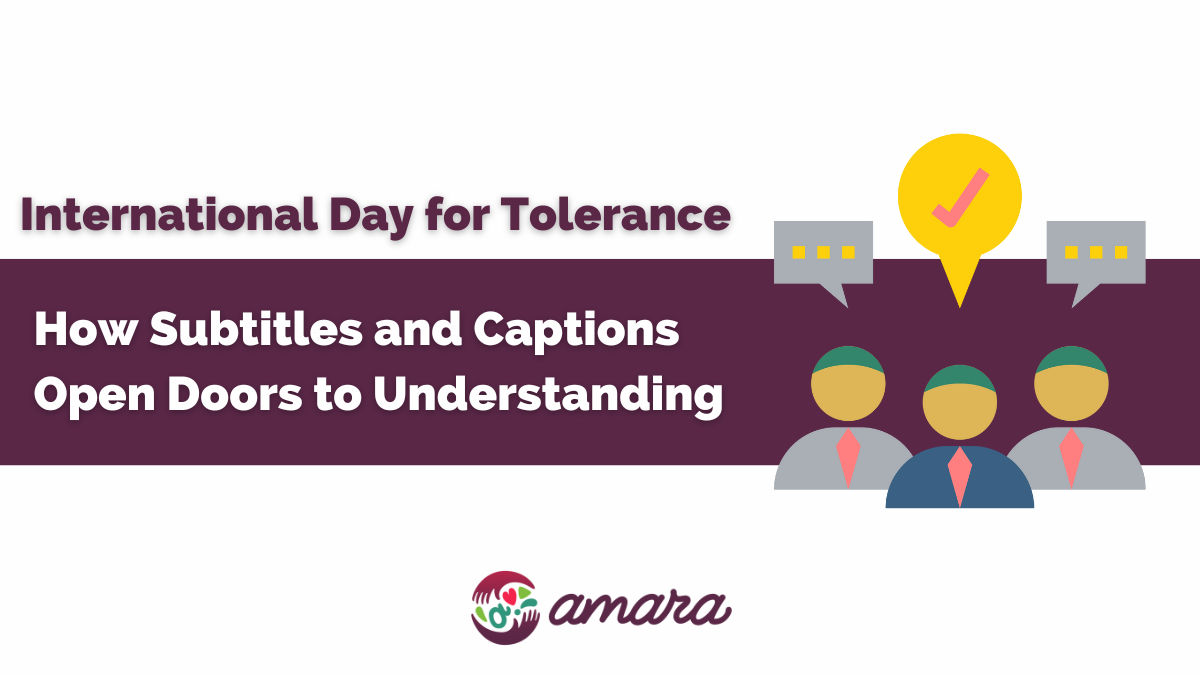
A rectangular image with the title of the article on the left-center, the title reads: International Day for Tolerance: How Subtitles and Captions Open Doors to Understanding. On the right-center, we have an illustration of three people with speech symbols on top of their head, the one in the middle contains a checkmark, demonstrating "understanding".

International Day for Tolerance: How Subtitles and Captions Open Doors to Understanding

Posted on November 18, 2025November 18, 2025 By amarasubs No Comments on International Day for Tolerance: How Subtitles and Captions Open Doors to Understanding

Every year on November 16, the world observes the International Day for Tolerance, a reminder of the importance of respecting diversity and fostering understanding among people of all backgrounds, languages, and cultures. In today’s interconnected world, one of the most powerful tools for building tolerance doesn’t come from political speeches or global summits—it comes from something as simple as words on a screen.

Breaking Barriers Through Subtitles and Captions

Language can unite, but it can also divide. Subtitles and captions bridge that divide. They make content—films, documentaries, educational videos, and even social media posts—accessible to people who speak different languages or individuals who are deaf or hard of hearing.

When creators add subtitles, they’re not just translating dialogue—they’re inviting people in. They’re saying, “You belong here too.” That message, repeated across millions of videos and stories, helps nurture empathy and mutual respect on a global scale.

Accessibility as a Path to Tolerance

Accessibility and tolerance are deeply connected. When content is accessible, it ensures that no one is excluded from cultural exchange or public conversation because of a disability, language barrier, or literacy difference.

  • Captions make sure people with hearing loss can fully experience media, participate in discussions, and express their perspectives.
  • Subtitles allow audiences to discover films, series, and creators from around the world, encouraging appreciation of cultures beyond their own.

Through this openness, people begin to see the world from different perspectives—and that’s the foundation of tolerance.

Global Stories, Shared Understanding

Think about how Korean dramas, Spanish-language films, and African documentaries have gained global audiences in recent years. Much of that success comes from subtitles. They make it possible for someone in France to enjoy a story from Nigeria, or a viewer in Mexico to connect with a film from Japan.

Each time we watch content from another culture and understand it through subtitles, we learn something about how others live, laugh, love, and dream. These shared emotional experiences remind us that, despite our differences, we have far more in common than we think.

The Human Touch Matters

Technology has made automatic translations easier than ever, but human subtitlers play a crucial role in preserving nuance and cultural meaning. They don’t just convert words; they translate humor, emotion, and context. That accuracy helps avoid stereotypes or misinterpretations that can lead to misunderstanding. When done thoughtfully, subtitles can foster authentic cultural exchange—a key ingredient for real tolerance.

Amara.org: Building a More Accessible and Inclusive Internet

At Amara.org, we believe that accessibility and inclusion go hand in hand. Our mission is to make online video more accessible to everyone—by breaking down the barriers of language and physical accessibility through captions and translated subtitles.

Since its founding, Amara.org has empowered individuals, organizations, and communities to collaborate on subtitling projects that open content up to audiences around the world. From nonprofits and educators to independent creators and major media outlets, Amara.org’s platform helps make sure that important stories, lessons, and ideas are not limited by language or ability.

By promoting accessibility, Amara.org supports the same values that the International Day for Tolerance celebrates—respect, understanding, and inclusion for all.

Impact: Words Build Bridges

Subtitles and captions may seem small, but their impact is profound. They help build bridges across cultures, empower understanding, and remind us that tolerance isn’t just a value—it’s a practice. Every time we make content more accessible, we take one step closer to a world where diversity is not just accepted, but celebrated.

A Call to Creators and Organizations

If you’re a creator, educator, or organization looking to make your content accessible to audiences worldwide, we’re here to help. Reach out to client-services@amara.org to learn more about how Amara.org can support your subtitling and captioning projects. Together, we can make your stories reach—and inspire—people everywhere. 🌍
Read these articles next

Accessibility and Captioning, Captions and Subtitles, Inclusion and Belonging Tags:accessibility, captions, day for tolerance, subtitles, tolerance, understanding

Post navigation

Previous Post: Honoring Native Heritage: The Role of Captions in Preserving Indigenous Languages and Stories
Next Post: Gratitude Around the World: Celebrations Like Thanksgiving and the Power of Accessible Storytelling

More articles to learn from

Rectangular image, with the title of the article highlighted at the top, "Celebrating Spanish in the United States. Why Subtitling Matters During Hispanic Heritage Month." Below is a heart-shaped illustration of diverse hands in different colors coming together, with the Amara logo in the lower-right corner. Celebrating Spanish in the United States: Why Subtitling Matters During Hispanic Heritage Month Accessibility and Captioning
Rectangular image with the title of the article at the top, “How Captions Can Support Literacy and Language Learning,” featuring an illustration of a women reading a book at a computer. The Amara logo is on the bottom-right corner. How Captions Can Support Literacy and Language Learning Accessibility and Captioning
Rectangular image with the title of the article highlighted a the top, "Broadcast Captions vs. Web Captions vs. OTT Subtitles: Choosing the Right Solution for Your Video Content". At the center, we have an illustration of a person working on a computer, with video content. The Amara logo is at the bottom-right corner. Broadcast Captions vs. Web Captions vs. OTT Subtitles: Choosing the Right Solution for Your Video Content Captions and Subtitles
Rectangular image. To the left, the title of the article, “What Are Language Codes? Why They Matter for Professional Subtitle Translation and Localization.” On the right are three overlapping speech bubbles in green, blue, and cream, featuring language-related symbols. The Amara logo appears at the bottom center. What Are Language Codes? Why They Matter for Professional Subtitle Translation and Localization Amara On Demand
Rectangular image highlighting the article title, "International Day of the World’s Indigenous Peoples: How Captions and Subtitles Help Preserve Indigenous Languages”. At the center, an illustration of two happy people communicating through speech bubbles containing a globe. Amara logo at the bottom. International Day of the World’s Indigenous Peoples: How Captions and Subtitles Help Preserve Indigenous Languages Audio and Video Transcription
Gráfico promocional con el texto: "Subtítulos para YouTube en español: cómo llegar a millones de personas dentro y fuera del mundo hispanohablante". A la derecha, un teléfono inteligente muestra un megáfono morado y amarillo rodeado de iconos coloridos relacionados con las redes sociales y la comunicación digital, como un corazón de "Me gusta", burbujas de chat, un botón de reproducción, un hashtag y un emoji sonriente. En la parte inferior central aparece el logotipo de Amara. Subtítulos para YouTube en español: cómo llegar a millones de personas dentro y fuera del mundo hispanohablante Artículos en español

Leave a Reply Cancel reply

Your email address will not be published. Required fields are marked *

Give us a follow:

  • Bluesky
  • Facebook
  • Instagram
  • LinkedIn
  • YouTube

Contact us at enterprise@amara.org

Powered by PressBook Grid Blogs theme