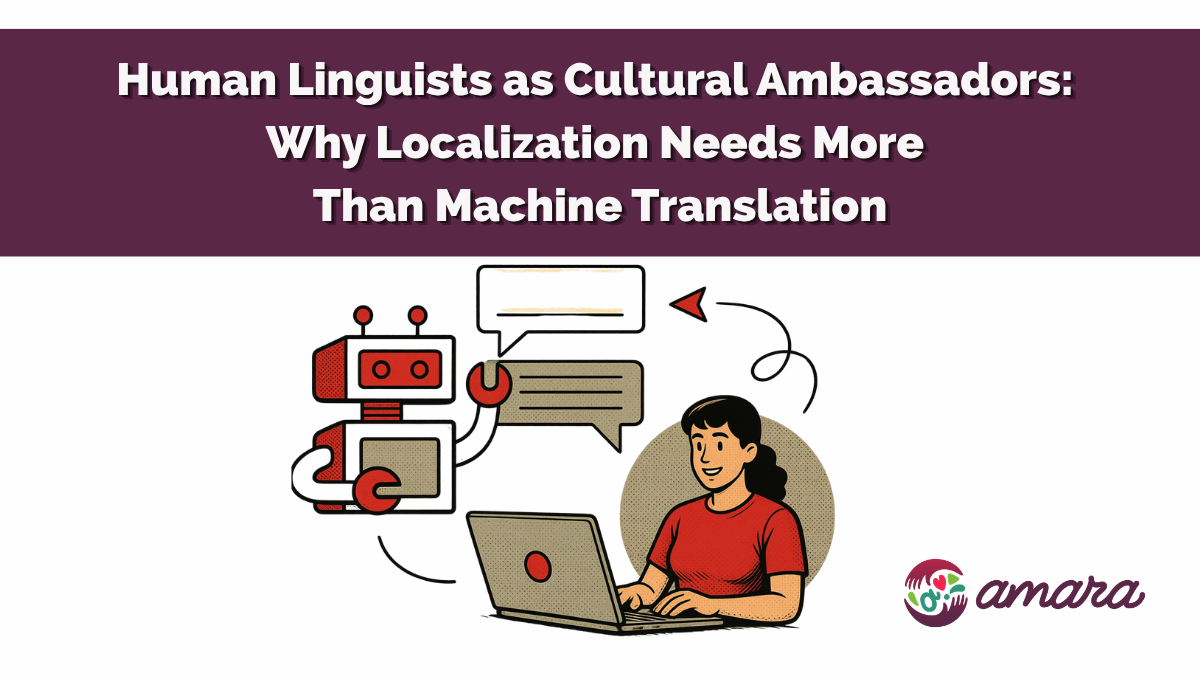
Translation Moves Words. Localization Builds Connections.
When a brand enters a new market, translating its content is only the beginning. To connect with people across languages and cultures, it must communicate in ways that feel natural, relevant, and appropriate to the audience.
A message that works beautifully in one country may sound confusing, overly formal, insensitive, or simply unconvincing in another. The words may be technically correct, yet the message may fail to achieve its purpose.
This is where human linguists make a difference.
Professional translators and localization specialists do more than convert words between languages. They interpret meaning, recognize cultural nuances, understand the subject matter, and adapt content to preserve the intended effect.
Human linguists are cultural ambassadors: they bridge the source culture and the target audience, helping brands communicate with authenticity rather than simply produce translated text.
As machine translation becomes increasingly accessible, this human expertise is an important way for organizations to distinguish themselves and build stronger relationships with audiences around the world.
1. Preserving Brand Voice Across Cultures
A brand’s voice is one of its most valuable assets. Whether a company communicates through humor, warmth, authority, innovation, or simplicity, that personality should remain recognizable across languages.
However, tone does not always transfer directly between cultures.
A playful expression in one language might sound childish in another. A slogan intended to convey confidence could come across as arrogant. A friendly customer-service message might sound distant or overly informal when translated without considering local conventions.
Imagine a fictional productivity app that uses the English slogan “Get your life together!” The phrase might feel motivational or humorous to its intended audience. But a literal translation in another language could sound judgmental, particularly if the brand aims to be supportive and encouraging.
A human localization expert would consider the brand’s personality, campaign objectives, audience expectations, and local communication conventions before adapting the slogan.
The final wording might be quite different from the original, yet it would preserve the intended message and emotional effect.
This is the essence of transcreation: adapting creative content to achieve a similar response in another language and culture rather than reproducing the original words literally.
Human experts help ensure that localized content sounds like the same brand speaking naturally to a different audience.
2. Understanding Cultural Nuances That Machines May Miss
Culture shapes the way people interpret language. Idioms, humor, social conventions, historical references, and everyday expressions can carry meanings that are difficult to infer from words alone.
Consider the English expression “Bring home the bacon.” In certain contexts, it means earning money or providing for one’s family. A literal translation, however, may communicate nothing more than bringing cooked meat home.
A machine translation system may produce a grammatically plausible version without fully conveying the idiom’s intended meaning. A human linguist can recognize the expression and determine whether the target language has a natural equivalent.
If no equivalent exists, the linguist can adapt the message to communicate the same idea in a culturally appropriate way.
The same challenge appears in advertising, entertainment, education, and corporate communications. Humor may depend on wordplay that cannot be reproduced directly. A cultural reference may be familiar to one audience but completely unknown to another. A phrase that sounds enthusiastic in one market may feel exaggerated in another.
Human linguists help identify these differences and determine the best way to address them.
3. Combining Language Skills With Subject-Matter Expertise
Cultural knowledge is essential, but effective localization also depends on understanding what the content is about.
Technical, medical, legal, financial, educational, and audiovisual content often requires specialized terminology and an understanding of industry conventions.
For example, a software company might use a single English term to refer to a user action, a technical process, and a product feature. Translating each occurrence without understanding the context could result in inconsistent terminology or misleading instructions.
A linguist experienced in software localization can identify the intended meaning, follow terminology guidelines, and ensure that the same concepts are communicated consistently across the product interface, help center, tutorials, and marketing materials.
Similarly, a professional working on a documentary about food needs to understand more than the language being spoken. Regional ingredient names, culinary techniques, traditional dishes, and culturally specific references may require research and specialized knowledge.
A qualified audiovisual translator with gastronomic expertise can distinguish between similar concepts, select appropriate terminology, and adapt an expression without losing the creator’s voice.
This combination of linguistic ability and subject-matter knowledge protects both accuracy and credibility.
4. Why Native-Level Language Knowledge and Local Insight Matter
A strong command of the target language is essential for effective localization. But language proficiency alone does not automatically guarantee cultural or professional competence.
The best results come from combining advanced linguistic skills with familiarity with the target market, relevant subject-matter knowledge, and a clear understanding of the source content.
A qualified linguist should be able to evaluate questions such as:
- Does the translation sound natural to the intended audience?
- Does it preserve the original meaning and the brand’s intended tone?
- Are the expressions and terminology appropriate for this market and industry?
- Could the wording carry an unintended connotation?
- Does the content meet the audience’s expectations and the project’s quality requirements?
These questions require judgment and context, not just a comparison of words.
Human experts also recognize that languages are not uniform. Spanish used in Mexico may differ from Spanish used in Spain or Argentina. English expressions vary across the United States, the United Kingdom, Australia, and other markets.
Even within a single country, communication styles can vary by region, audience, industry, and context.
Effective localization takes these differences into account rather than treating a language as a single, interchangeable market.
5. The Risks of Letting Automated Output Speak for Your Brand
Machine translation can be a valuable part of a localization workflow. The risk arises when organizations assume that its output is ready for publication simply because it is understandable.
Imagine a company launching a campaign in ten languages. The original English message is warm, conversational, and reassuring. If automated translations are published without appropriate review, the campaign might communicate ten slightly different versions of the brand’s personality.
Some audiences may receive a message that sounds stiff or impersonal. Others may encounter awkward idioms, inconsistent terminology, or language that does not fit local expectations.
The result may be a fragmented brand experience, even if every translation is broadly understandable.
In more specialized contexts, the consequences can be more serious. Ambiguous instructions may confuse customers, inaccurate terminology may undermine credibility, and poorly adapted public-facing content may create avoidable misunderstandings.
The solution is not to reject machine translation. It is to recognize that its output must be evaluated according to the content’s purpose, audience, and risk.
Human linguists can identify issues that automated checks may not catch and help ensure that the final message is appropriate for publication.
Human Expertise Makes Global Communication More Human
Successful localization depends on understanding both what a brand wants to say and how its audience is likely to receive that message.
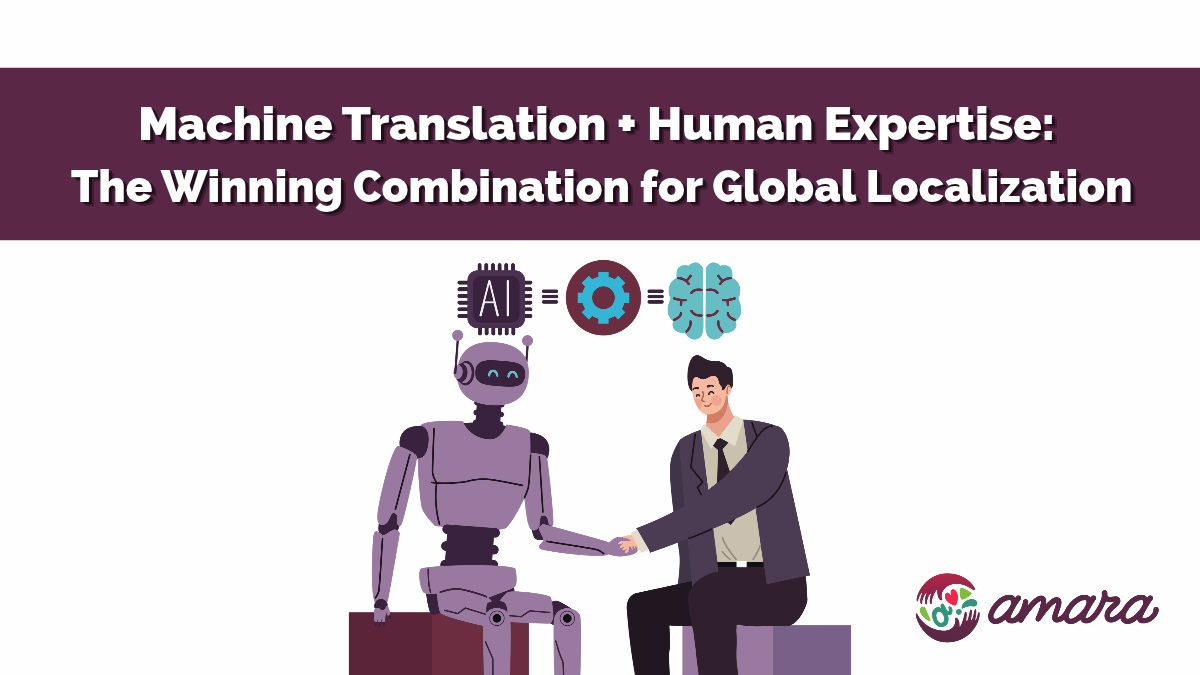
Machine translation can help organizations increase speed and scale. Human linguists bring the cultural awareness, subject-matter knowledge, and professional judgment needed to make that scale meaningful.
They are cultural ambassadors who connect languages, interpret context, preserve brand identity, and help information travel across cultural boundaries without losing its purpose.
For organizations expanding internationally, this is more than a quality-control measure. It is an investment in effective communication and long-term relationships with audiences.
Make Your Audiovisual Content Meaningful Across Languages
At Amara.org, we believe that making audiovisual content accessible to global audiences involves more than making words available in different languages. Subtitles, captions, and transcripts must convey meaning in ways that audiences can understand and engage with.
Our professional language services help organizations localize audiovisual content through captioning, transcription, and subtitle translation, supporting multilingual communication while respecting the intent and context of the original material.
Whether you are producing educational videos, marketing campaigns, documentaries, or other audiovisual content, working with language professionals can help you reach more people without losing the message that makes your content distinctive.
Let your content speak to the world. Contact Amara at client-services@amara.org to discuss your multilingual subtitling and captioning needs.