
Michael Lockrey is Deaf, which means he depends on high quality captions for the videos he watches on the web.
Unfortunately, many YouTube videos that are captioned use automatically generated captions. Automated captions are often inaccurate and, uncorrected, they can do more harm than good. This is partially due to the perception creators have, when they think automated captions are “good enough”. In light of this situation, Michael has taken a hands-on approach to making change.
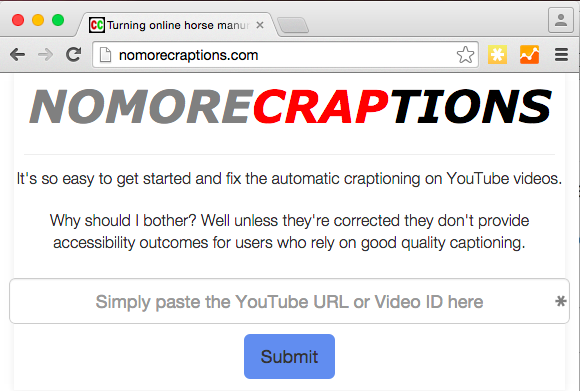
Michael built a website and tool called nomoreCRAPTIONS to challenge the prevalence of automatic captions (or “craptions” as Michael likes to call them). nomoreCRAPTIONS is a simple tool for improving automated captions, but it’s also a campaign to raise awareness about the importance of accurate captions for all web videos.
 We had a chance to catch up with Michael and learn more about his efforts:
======
Amara: How do you explain nomoreCRAPTIONS to people?
Michael: nomoreCRAPTIONS was designed to be the easiest way to fix up the automatic craptions on shorter YouTube videos (i.e. up to 2 or 3 minutes in duration).
We’ve deliberately focused on leveraging the intrinsic value in automatic craptions as it’s usually quicker to fix up these auto-generated craptions rather than starting from scratch.
The other main benefits of nomoreCRAPTIONS are that:
There’s no barriers or learning curve – you simply plug in the link to the YouTube video you want to fix up. This means that it’s very easy for anyone* to roll up the sleeves and fix up the errors in the auto-generated craptions.
* (anyone === who can hear)
You don’t have to be the content owner and this means that you don’t need to wait days / weeks / months (or even years) to watch the captions (as any corrections are instantly available on the nomoreCRAPTIONS website).
Amara: What motivated you to start the project?
Michael: As a Deaf man, I need good quality captions to watch online video content and it’s well known that YouTube is the biggest repository of online videos.
In the past if I’ve come across a viral or otherwise interesting video on YouTube that I’d like to watch – invariably it won’t have good quality captioning and I’ve been unable to do so.
YouTube has admitted recently that only 25% of YouTube videos have captioning and most of these only have automatic craptioning, which doesn’t provide me with any accessibility outcomes and I wrote a blog post recently that suggests that this means that only 5% of YouTube videos are likely to have good quality captioning and this simply isn’t good enough.
So you could say that nomoreCRAPTIONS has also become a bit of a personal protest against Google and YouTube’s over-use of automatic craptions and perhaps also a “cry for help” for them to do more.
Amara: How do you underline the importance of nomoreCRAPTIONS?
Michael: The lack of captioning on YouTube videos and other online video platforms is one of the biggest accessibility issues on the web today.
But it’s very hard to get this message through to the general public and as the internet is largely an unregulated environment it means that the advocacy strategies that made captioning available on almost 100% of traditional media such as TV in the USA, UK and Australia will not necessarily be effective as more and more content shifts onto the internet.
As a result I’m a very strong believer that we have a huge fight on our hands to gain accessibility to online video content and the best way to achieve this is by making it simple and easy to add good quality captioning.
Amara: Do you have a favorite story about nomoreCRAPTIONS? Any exciting impact that you’ve seen?
Michael: My favourite story to date has been working closely with my father on YouTube captioning using the nomoreCRAPTIONS tool.
He’s retired and he’s also lost quite a bit of hearing as he’s now well into his 70’s which means that rather than him and I being some sort of dynamic captioning duo akin to an #A11Y Batman and Robin, we’re probably have more in common with the two guys from Dumb and Dumber!
But he’s really enjoyed using the nomoreCRAPTIONS tool and he’s now even volunteering to provide the captions for the Australian War Memorial YouTube channel as he has a lot of family members who served in previous wars and he’s very interested in learning about the family history etc.
It was also great to work with Amara and many of their volunteers recently on an advocacy project that is trying to get the New York Times to caption their online videos.
Check out our public Trello project page and whilst it doesn’t use nomoreCRAPTIONS (as the New York Times has actually disabled the automatic craptioning on their YouTube channel) we have used an innovative workflow where we focus on creating an accurate text transcript first and then upload this onto the web where it is synced to the audio track.
Many of the volunteers have raved about how it’s so good to not have to manually sync the text to the audio track and it’s a significant saving of 20-30% of the standard captioning workflow time, which means that volunteers can create even more accessibility outcomes.
Amara: Where would you like to see nomoreCRAPTIONS go in 2015?
Michael: The best thing that could happen in 2015 for nomoreCRAPTIONS would actually be a nail in our coffin – we want Google and YouTube to cease publishing the automatic craptions immediately.
Instead we’d love to see Google and YouTube be far more proactive on ensuring that captions happen, particularly for the bigger channels and content producers, such as the New York Times.
For example, they could easily prompt users whilst they’re waiting for videos to upload onto their channel to make sure their videos are captioned or they could even ask users to caption the first 15 – 30 seconds of a video, etc.
Another thing I’d like to see is for much more “low hanging fruit” to be captioned and it would be great to see some “quick wins” up on the A11Y-scoreboard.
By this I’m simply referring to videos (such as those by the Australian Prime Minister, Tony Abbott, where there’s already an accurate transcript published on the Australian Government’s website and it’s also usually added to the meta data on their YouTube video page) but the videos themselves are still not captioned.
Check out the links here:
Screenshot showing the full transcript in the YouTube video’s meta-data section:

TEDx Talks are another good example – as most presenters would have a written script, that can be easily uploaded and automatically converted into a very accurate caption file.
Amara: Are there ways people can help with nomoreCRAPTIONS and/or get involved in the larger captions/accessibility movement?
Michael: nomoreCRAPTIONS is an open source project and we are currently receiving some great support and mentoring assistance from the team at Free Code Camp. This means that we have some students working on the next version of nomoreCRAPTIONS with node.js support and numerous other improvements.
Our product roadmap for nomoreCRAPTIONS also includes some new tools that will make it more efficient for captioning longer videos (as we usually don’t recommend using the existing nomoreCRAPTIONS tool for videos of more than 3 minutes in length).
======
We’re very grateful to Michael for sharing his time and thoughts – we’ll continue to stay in touch and bring updates. If you’d like to learn more about his efforts and/or get involved with nomoreCRAPTIONS, please check out the links below.


Wonderful interview. All CCAC’ers know Michael well :-) since he was an early member and a great captioning advocate in many places. You can see Michael himself in the short CCAC film, “Don’t Leave Me Out!” both in the opening sequence, and among many others who understand the world’s need for quality captioning everyday – go to the page and select your language – enjoy.
This video is hilarious and really makes Michael’s point. Unfortunately they only used auto captions for the initial explanation section of the video: https://www.youtube.com/watch?v=23H8IdaS3tk